
That Frustrating Moment When Your Garage Door Won't Stay Closed
You press the button on your remote, watch the garage door glide downward, and then — just inches from the floor — it stops and reverses right back up. You try again. Same thing. Maybe you try holding the wall button, and it finally closes, but the next time you use the remote, the problem returns.
This is one of the most common garage door issues we see here in St Johns, and it's one that homeowners often misdiagnose. Before you start replacing parts or calling it quits, let's walk through the real reasons your garage door reverses before hitting the floor and what you can do about each one.
Understanding Your Garage Door's Safety System
Before diving into causes, it helps to understand why your garage door is designed to reverse in the first place. Every modern garage door opener manufactured after 1993 is required by federal law to include two safety features:
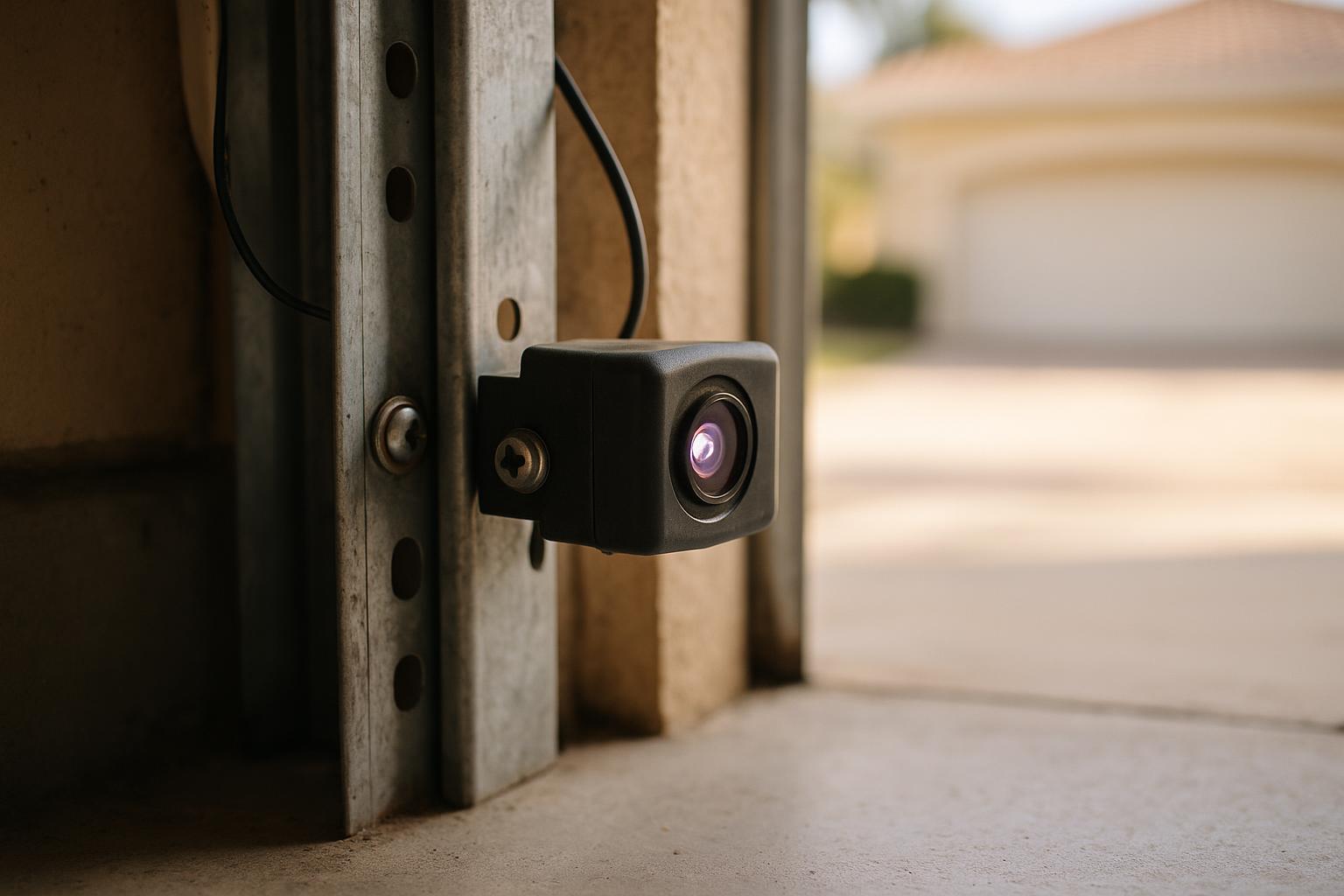
- Photo-eye sensors: Two small sensors mounted near the bottom of the door tracks on either side. They send an invisible beam across the opening. If something breaks that beam, the door reverses.
- Auto-reverse mechanism: If the door encounters physical resistance while closing — like hitting an object or the floor too hard — it automatically reverses direction.
Both of these systems are designed to prevent injuries and property damage. But when they malfunction or are improperly adjusted, they can cause your door to reverse even when nothing is actually in the way.
Cause #1: Misaligned Photo-Eye Sensors
This is the number one reason garage doors reverse prematurely, and it's especially common in St Johns homes where afternoon sun, lawn debris, and even lizards can interfere with the sensors.
Your photo-eye sensors need to be perfectly aligned with each other. If one gets bumped — maybe by a bike, a trash can, or a child — the beam is broken and the door thinks something is in the way.
What to Check
- Look at the LED lights on each sensor. Most models show a steady green light on one and a steady amber or green light on the other when properly aligned. A blinking light usually means misalignment.
- Gently adjust the sensor that's blinking until the light becomes steady.
- Clean the sensor lenses with a soft cloth. Dust, cobwebs, and pollen — all plentiful in our Florida climate — can block the beam.
Cause #2: Incorrect Close-Limit Settings
Your garage door opener has close-limit settings that tell it how far the door should travel before it's considered fully closed. If this setting is off, the opener thinks the door has hit an obstruction when it's really just reaching the ground.
The result? The auto-reverse kicks in and sends the door right back up.
What to Check
- Locate the limit adjustment screws on your opener unit — they're usually labeled "up" and "down" or marked with arrows.
- If the door reverses right at the floor, try turning the down-limit screw in small increments (usually a quarter turn at a time) and testing the door after each adjustment.
- Be careful not to over-adjust. If the door presses too hard against the floor, it will also trigger the auto-reverse.
Cause #3: Worn or Broken Springs
Garage door springs do the heavy lifting — literally. They counterbalance the weight of the door so the opener doesn't have to work as hard. When a spring is worn, weakened, or broken, the door becomes significantly heavier for the opener to manage.
In some cases, a weakened spring causes the opener to sense too much resistance on the way down, triggering a reversal. You might also notice the door feels heavier when you try to lift it manually or that it doesn't stay open on its own.
Important: Garage door springs are under extreme tension and can cause serious injury if handled improperly. Spring replacement is one repair we strongly recommend leaving to professionals. Our team handles spring replacements throughout St Johns, Jacksonville, and St Augustine regularly, and we carry the most common sizes on our trucks for same-day service.
Cause #4: Track Problems
Bent, misaligned, or obstructed tracks can create resistance that the opener interprets as a blockage. Even a small dent in the track can cause the rollers to bind, which triggers the auto-reverse.
What to Check
- Visually inspect both tracks from top to bottom. Look for dents, bends, or gaps where the track has pulled away from the wall.
- Check for debris in the tracks — small rocks, leaves, or even hardened dirt can cause problems.
- Make sure the tracks are properly lubricated. Dry tracks create friction that can mimic an obstruction.
Cause #5: Opener Force Settings Need Adjustment
In addition to limit settings, most garage door openers have force settings that control how much power the motor uses to open and close the door. If the close force is set too low, the opener gives up too easily and reverses.
This sometimes happens after a power outage resets the opener or after a new opener is installed without proper calibration. It's also common in older openers that have gradually lost power over the years.
What to Check
- Find the force adjustment screws or settings on your opener. On newer models, this may be a digital setting accessed through a control panel.
- Increase the close force slightly and test the door.
- After adjusting, always test the auto-reverse safety feature by placing a 2x4 flat on the ground under the door. The door should reverse when it contacts the board. If it doesn't, reduce the force — safety always comes first.
Cause #6: Wiring Issues
Frayed, damaged, or loose wiring between the sensors and the opener can send inconsistent signals that cause erratic behavior, including random reversals. Florida's heat and humidity can accelerate wire degradation, especially in garages that aren't climate-controlled.
If you've checked everything else and the problem persists, a wiring issue may be the culprit. This is another situation where calling a professional is the safest and most efficient route.
When to Call a Professional
Some of these fixes — like cleaning sensors or making small limit adjustments — are safe for most homeowners to try. But if the problem persists, involves springs, or you're not comfortable working with the mechanical and electrical components of your garage door system, it's time to call in help.
At St Johns Door & Opener, we diagnose and fix reversing issues every week for homeowners in Fruit Cove, Julington Creek, Ponte Vedra Beach, and throughout the St Johns area. We show up on time, explain what we find in plain language, and only recommend repairs that are actually necessary.
Whether it's a simple sensor realignment or a full spring replacement, we'll get your garage door closing properly again — usually in a single visit.
Don't Ignore a Reversing Garage Door
A garage door that won't close isn't just an inconvenience — it's a security risk. An open garage is an invitation for theft, pests, and weather damage. And if you've been propping the door closed manually or disconnecting the opener to force it shut, you could be creating additional safety hazards.
If your garage door keeps reversing and you can't pinpoint the cause, give us a call. We offer emergency garage door service for urgent situations and flexible scheduling for everything else. Let's get your door working the way it should.